
WhatsApp campaigns explained
WhatsApp opens a two-way conversation with your customers, with far higher read and reply rates than email or SMS, and the ability to book, answer and sell in the same chat.
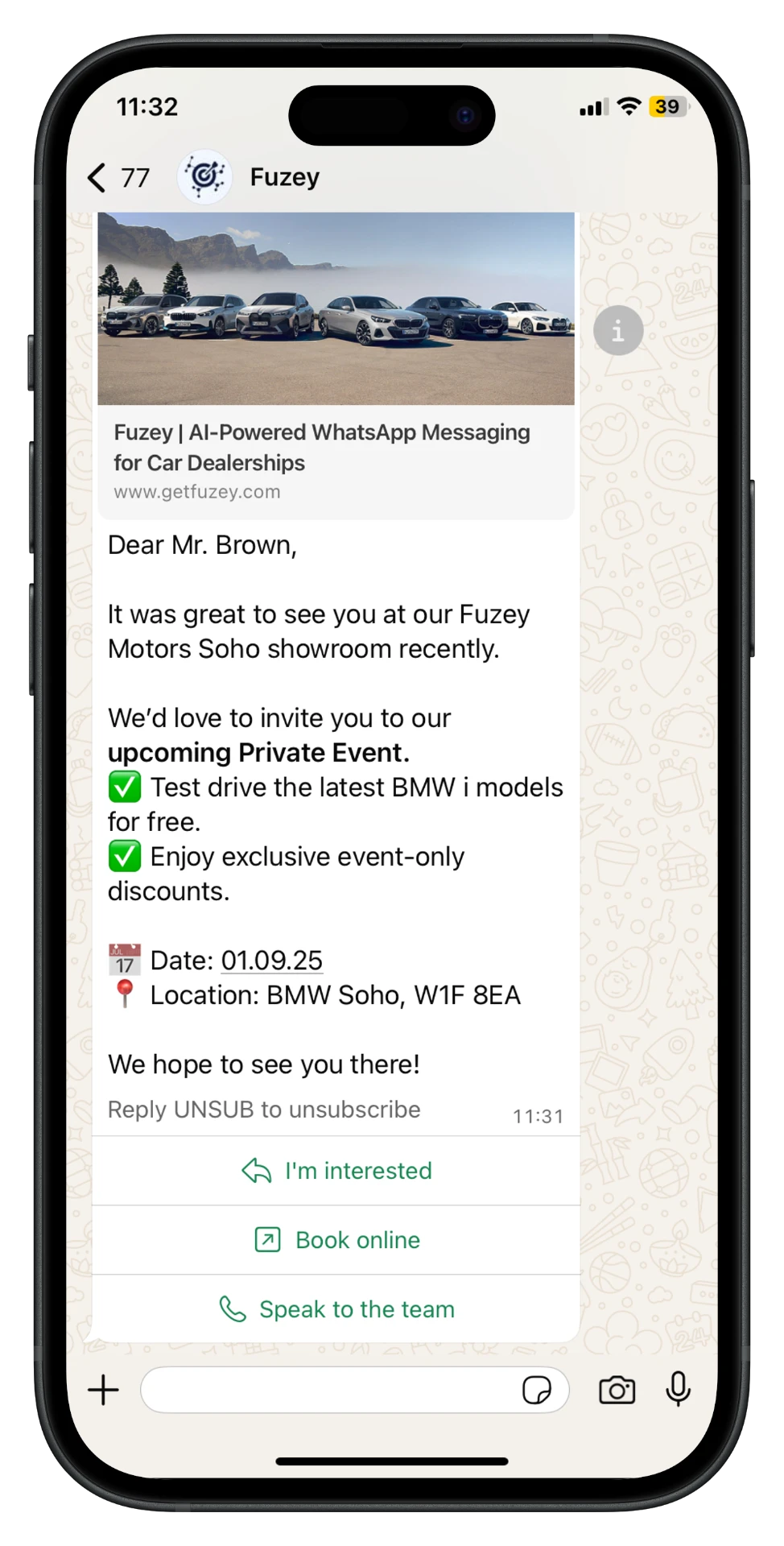
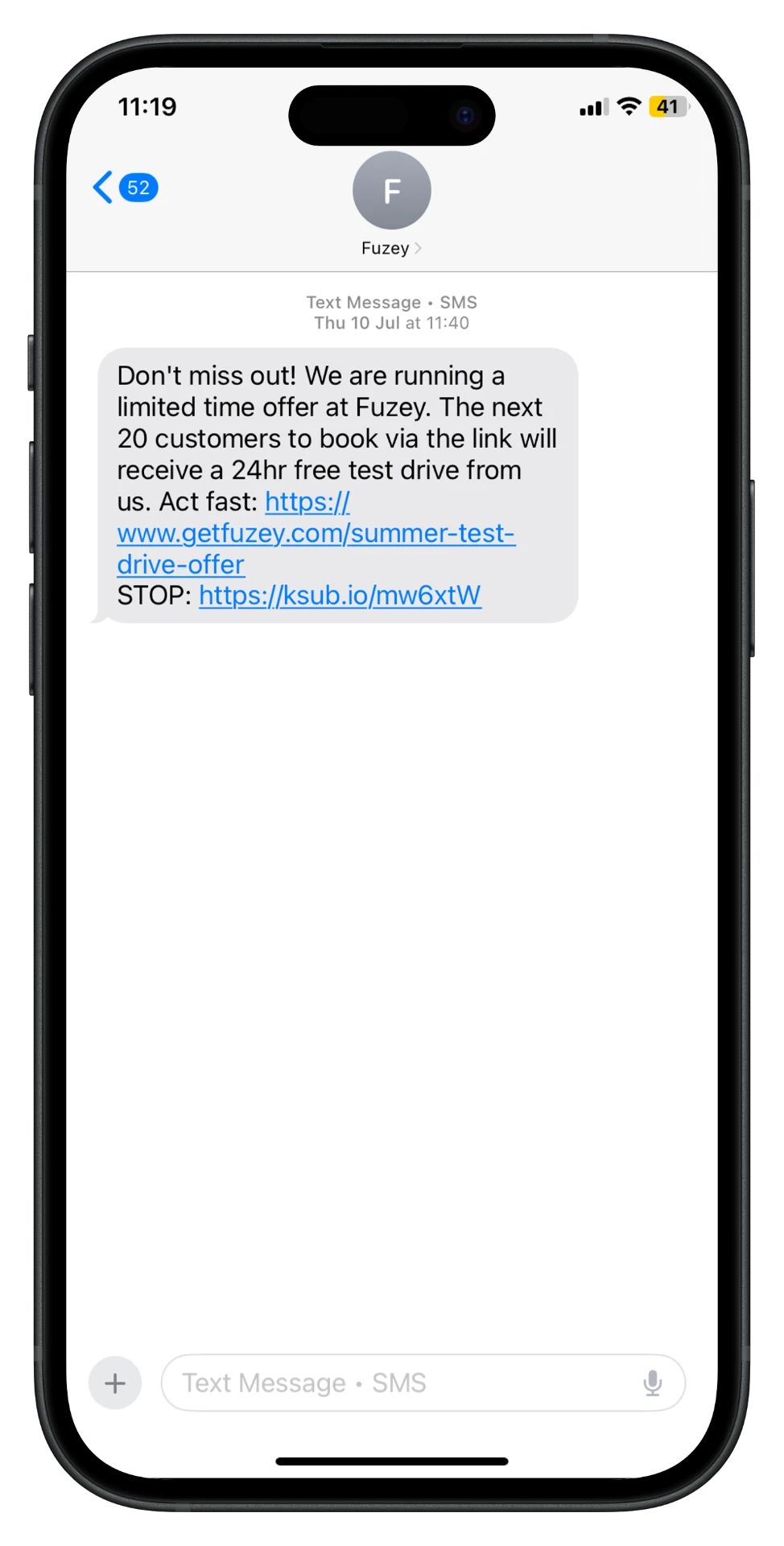
Email open rates for automotive sit around twenty to thirty per cent, and most of those never get past the subject line. SMS does a little better, but it is a dead end: a plain link, no image, no buttons, and nowhere for the customer to reply. WhatsApp is the first channel that lands in the place your customers already check dozens of times a day, and then lets them answer you back in the same breath.
That is the real shift for a dealership. A WhatsApp campaign is not a one-way broadcast that disappears into a spam folder. It is the opening move of a two-way conversation, sent to customers who have opted in, personalised with their name and their vehicle, and tracked from delivery through to reply and booking.
When the message earns a reply, the customer stays in the chat. They ask about a slot, confirm a price, send a photo of the part exchange, and book, all without being pushed out to a form or a phone queue. Fuzey is built around that window, which is where the engagement, and the revenue, actually happens.
What people mean by a WhatsApp campaign
There are three different things sitting under the same name, and only one of them is a real marketing channel for a dealership.
Broadcast lists on the WhatsApp Business app. Free, capped at 256 contacts per list, and only delivered to people who have already saved your number in their phone. Fine for a barber. Useless for a group with 40,000 customer records.
WhatsApp Channels. A one to many feed that people choose to follow. No replies, no personalisation, no idea who is on the other end. Good for broadcasting news to fans. It is not connected to your DMS and it will not tell you that Mrs Patel wants her MOT booked for Thursday.
Marketing template messages through the WhatsApp Business API. A message you write, Meta approves, and you send to a segment of opted in customers. It lands in the same inbox as their family chats, it is personalised with their name and their vehicle, and when they reply you get a real conversation with a real person. This is the one worth building a strategy around, and it is what the rest of this article is about.
A WhatsApp campaign is not a newsletter. It is the start of a conversation that happens to go out to a few thousand people at once.
How it actually works
The mechanics are not complicated once you have seen them.
- You need a WhatsApp Business API number. Not the free app. The API number is verified against your business, carries the green tick if you apply for it, and can send at volume. Each retailer in a group normally has its own number so the customer sees the site they actually bought from.
- Customers have to opt in. Opt in can come from a booking form, a service check in, a website widget, a QR code on the forecourt, or an existing communication preference in your DMS. It has to be clear that they are agreeing to receive WhatsApp messages from you. A customer who has opted in to SMS has opted in to receive SMS, not WhatsApp, so the channel matters at capture. This is not a technicality. It is the single biggest predictor of whether your campaigns keep working. See the WhatsApp Business policy for the full detail.
- Your message gets approved as a template. Marketing templates go to Meta for review before you can send them. Approval usually takes minutes, occasionally longer. Templates can include images, buttons, quick replies and a link.
- You choose who receives it. This is where dealership data earns its keep. Vehicle age, last service date, MOT due date, model, finance end date, site. A message to 800 people who own a five year old Golf with an MOT due next month will always beat a message to 8,000 people who own something.
- You send, and then you reply. The point of WhatsApp is what happens after delivery. Replies come back into a shared inbox where the service team, the sales team or an AI assistant can pick them up and book something.
It is worth designing the campaign around that window rather than around the template. The template only has one job, which is to earn a reply. Everything that actually makes money, the availability check, the courtesy car question, the price for the tyres, the photos of the part exchange, happens in free form messages afterwards.
In practice that means three things.
- Give people something easy to tap, because a quick reply button turns a passive read into an open conversation.
- Make sure someone is there to answer quickly, since a reply that sits unanswered for a day has usually gone cold by the time you get to it.
- Use the window properly by finishing the job in the chat, sending the booking slot, the finance quote or the payment link rather than pushing the customer out to a form.
The rules you need to know
Meta has tightened this considerably, and most of the complaints about WhatsApp campaigns not working trace back to one of the following.
Frequency capping. A WhatsApp user can only receive around two marketing template messages in a 24 hour period, and that limit counts every business messaging them, not just you. If your customer has already had one from a supermarket and one from an airline that morning, your message fails with error 131049 no matter how clean your account is. Spacing your sends and avoiding the obvious peak times genuinely helps.
Quality rating. Every WhatsApp Business number carries a quality rating driven by blocks and reports. If it drops, your daily messaging limit drops with it, sometimes very sharply. Blocks hurt far more than opt outs, which is exactly why you should make opting out easy.
Messaging limits and tiers. New numbers start with a low daily limit on unique recipients and work upwards as you send well. You cannot go from zero to a 40,000 contact send in week one. Plan a ramp.
Categories. Meta sorts every template into marketing, utility, authentication or service. A service reminder with the booking details is utility and costs a fraction of the marketing rate. Put a discount code in it and it becomes marketing. Getting your categories right is the cheapest saving available.
Opt out. Give people a clear way to stop. A "Stop" quick reply button that automatically updates the contact record is the standard, and it protects your quality rating.
What a good dealership WhatsApp campaign looks like
Short. Specific. Personal. Asking for one thing.
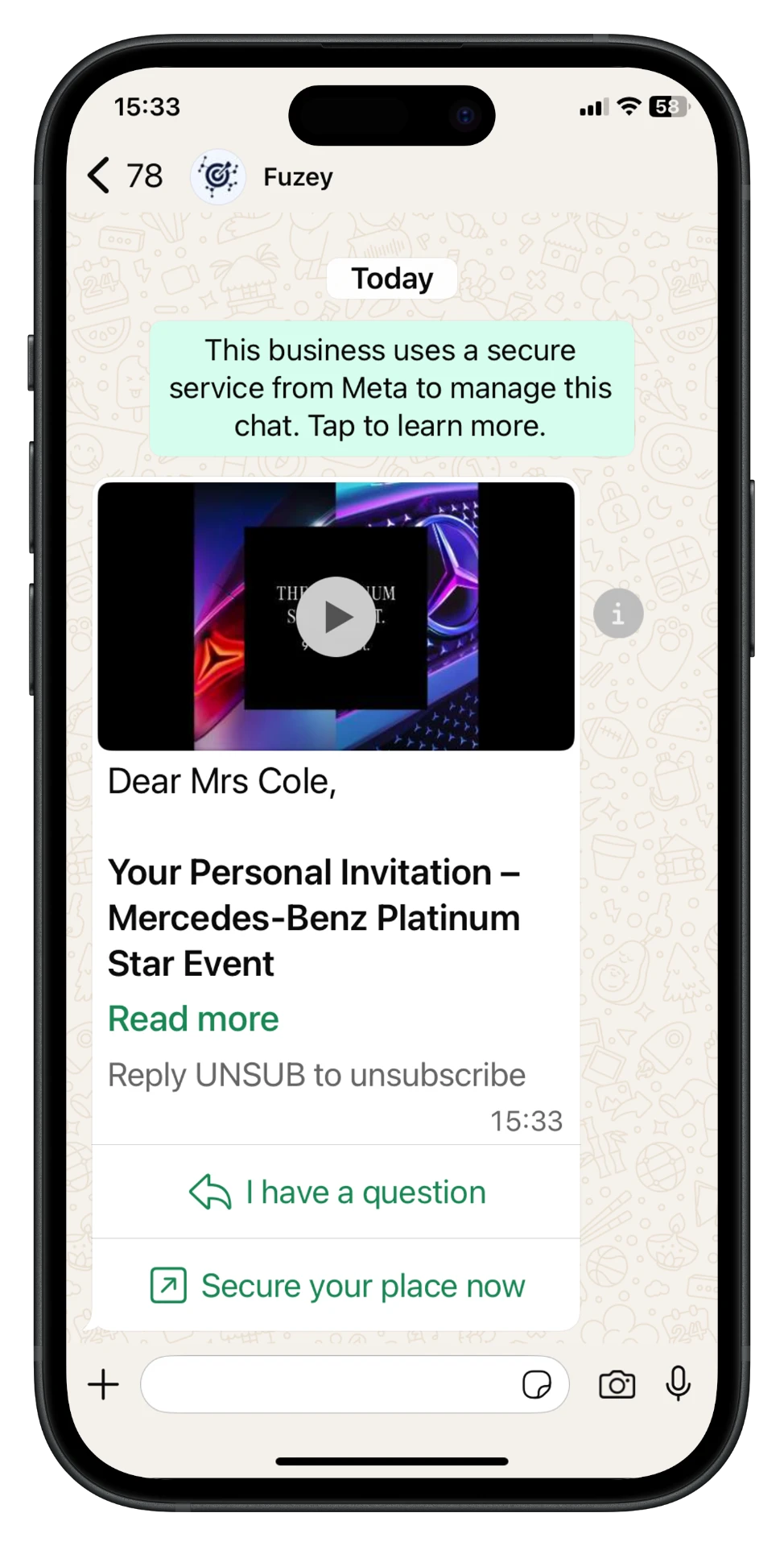
The best performing campaigns we see across our dealer groups tend to be one of these.
The service and MOT reminder with a booking button. Sent to a segment based on the actual due date, with the vehicle registration in the message. This is the workhorse and it usually pays for everything else.
The new model or launch event invite. Sent to owners of the outgoing model and to your enquiry database. Include the date, the site and a reply prompt. Do not attach a brochure.
The part exchange or valuation prompt. Sent to customers approaching the end of a finance agreement. Ask a question rather than making a claim. "Would you like to know what your Tiguan is worth this month?" beats anything with the word "exclusive" in it.
The seasonal check. Winter checks, air conditioning, tyres. Genuinely useful, low pressure, and it warms up a database before a bigger campaign.
The aftersales offer. One offer, one deadline, one button.
What does not work: long copy, three competing calls to action, stock photography of a family laughing near a car, and anything that reads like it was written for email and pasted into WhatsApp.
How to measure it
Delivery rate first, because it tells you whether the rules or the copy are the problem. Then read rate, which on WhatsApp should be high enough that a low number means something is wrong. Then reply rate, which is the number that actually matters, because replies are where bookings come from.
Attribute properly. Look at bookings created within a sensible window after the send, not just clicks. A customer who reads a WhatsApp message on Tuesday and phones the service department on Thursday is a result of the campaign, even though nothing was clicked.
Track opt outs and blocks separately. Opt outs are healthy. Blocks are a warning.
Getting started
If you are a dealer group thinking about this, the order of work is roughly:
- Get a verified WhatsApp Business API number for each retailer.
- Clean and consolidate your opt in data, and fix how you capture it going forward.
- Connect your DMS so segments build themselves rather than living in a spreadsheet.
- Build two or three templates and get them approved.
- Start with a small, well targeted send and grow from there.
- Make sure someone, or something, is ready to answer the replies.
That last point is the one groups underestimate. A campaign to 5,000 customers with a 10 per cent reply rate produces 500 conversations. That is a good problem, but only if you have planned for it.
FAQ
Is a WhatsApp campaign the same as a WhatsApp Channel?
No. A Channel is a public feed people choose to follow, with no replies and no personalisation. A WhatsApp campaign in the sense dealers mean is a marketing template message sent to opted in customers through the WhatsApp Business API, and customers can reply to it.
Do customers have to opt in?
Yes. Meta requires a clear opt in before you send marketing messages, and your delivery and quality rating depend on it. Opt in can be collected through booking forms, service check ins, website widgets, QR codes or your DMS preferences.
How many WhatsApp campaigns can I send a month?
Two or three at most for the same customer, and fewer is usually better. Meta limits how many marketing messages any individual receives in a day across all businesses, and frequency is the fastest way to lose a customer's attention on this channel.
Can I send a WhatsApp campaign from the free WhatsApp Business app?
Only as a broadcast list, capped at 256 contacts, and only to people who have saved your number. It does not scale, it does not personalise, and it does not report. Dealer groups need the API.
Why did my WhatsApp campaign fail to deliver?
Most commonly frequency capping, where the recipient has already received their daily allowance of marketing messages from other businesses. It can also be a low quality rating, a messaging limit, an invalid number or a customer who has blocked you.
Can WhatsApp campaigns integrate with my DMS?
Yes. Fuzey connects to Keyloop and other major dealer systems, so segments such as MOT due dates, service history and finance end dates build automatically rather than being exported by hand.
Keep reading
Writing WhatsApp templates people actually reply to
Learn how to write WhatsApp templates that pass approval and get replies, with practical tips on tone, timing, buttons and personalisation.
Read article
Missed call, lost sale
A missed call does not have to mean a lost sale if you turn it into a WhatsApp chat your team can pick up quickly.
Read article
Why your customers read WhatsApp and ignore your emails
Customers treat WhatsApp like a personal inbox, which is why dealership messages get noticed there and ignored in email.
Read article