
Reading the room at scale
In-depth customer sentiment reviews show dealerships what keeps coming up, what customers love and what they complain about, straight from everyday conversations.

Most unhappy customers do not say it plainly. They hint at it in short replies, repeated questions, a shift in tone, or the moment a polite message turns clipped.
By the time a complaint is formal, the damage is often done. The customer has had too many handoffs, waited too long, or repeated themselves once too often.
That is why sentiment reporting matters in dealership conversations. Used well, it is both an early warning system and a running account of what your customers actually think.
In-depth sentiment reviews, not just a score
Fuzey produces detailed customer sentiment reviews from the conversations your team is already having. Instead of a single number, you get a picture of the themes running through your customer base.
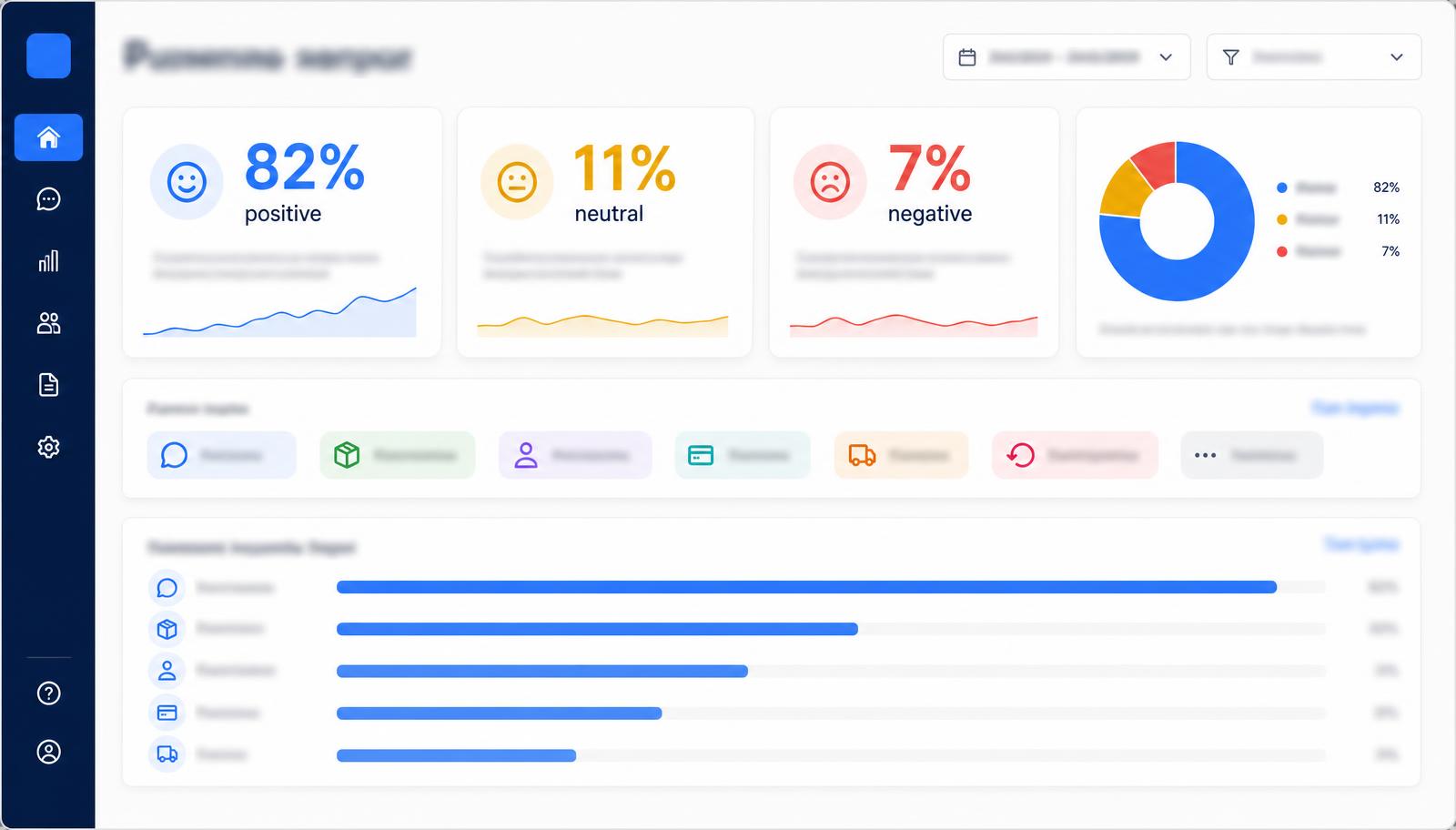
The review shows you what topics keep coming up, what customers are happy about and what they are complaining about. Courtesy cars, collection times, parts delays, finance paperwork, the quality of updates — whatever is really driving the mood, you can see it named and sized.
That makes it easy to stay on top of customer sentiment and improve where it counts, rather than reacting to whichever review happened to land this week.
These reports are powered by your daily communication. Because so much of it happens on WhatsApp, where customers actually reply, the volume and honesty of the conversation give you a level of detail that surveys and review sites simply cannot produce.
The real value is timing
A service customer asking for an update may sound calm at first. A few exchanges later, the language can harden because nobody has answered the actual question.
If you spot that shift early, you can act before the relationship gets worse. A quick call, a clearer explanation, or a manager stepping in can change the outcome.
This is where two-way conversation data becomes useful. Instead of relying on surveys after the event, you can see frustration building in live exchanges across sales, service and aftersales.
What rising frustration looks like in practice
Sentiment is rarely one dramatic message. More often it appears as a pattern across a conversation.
A customer starts chasing. They ask the same thing in a different way. Their replies get shorter, more direct, and less forgiving.
In a dealership, that might be a delayed repair, confusion over collection times, uncertainty around finance paperwork, or silence after a promised call back. Each message alone may not look serious, but together they tell you the room is changing.
Good reporting should surface those signals without asking managers to read every thread. It should flag where tone is slipping, show which teams or sites see more of it, and help leaders understand what tends to happen next.
The point is not to label a customer as negative. The point is to give your team enough warning to respond like humans, while there is still time.
Why this matters more than another score
Dealerships already have plenty of numbers. Another score on a dashboard is not automatically useful.
Sentiment matters when it leads to action. If a conversation is deteriorating and nobody knows, the score changes nothing. If it triggers the right intervention, it becomes useful.
That is why it is better seen as triage. Which conversations need attention now. Which customers have gone quiet after sounding frustrated.
It also fixes a common reporting problem. Teams can look healthy on averages while individual customers still have a poor experience.
Conversation-level signals make those hidden cases visible. Leaders do not just see that messages were sent. They see where confidence dropped and where escalation should have happened sooner.
How to make it useful for real teams
For sentiment reporting to help, it needs context. A frustrated message is not always a failure by the team. Sometimes the customer is reacting to a part delay, an insurer, or a manufacturer process outside the dealership's control.
That is why managers need to see sentiment alongside the thread, response times, handoffs and outcomes. The signal should point them to the right conversation, not pretend to explain everything on its own.
It also needs to fit the pace of the day. Service leaders do not have time to dig through long reports. Sales managers are not going to scroll through dozens of chats to find one upset customer.
The reporting has to bring the right conversations to the surface and make next steps obvious. Who needs a call. Who needs a clearer update. Which process is causing the same tension again and again.
From visibility to intervention
The best reporting does not stop at telling you a customer is unhappy. It helps the team decide what to do next.
That may mean prioritising a call back, routing a thread to a senior adviser, or spotting when an AI agent should hand over because the conversation has become sensitive. In that sense, sentiment analysis supports service standards without replacing judgement.
It can also help leaders coach more fairly. Instead of relying on the loudest complaint or latest bad review, they can look at how conversations develop over time and support teams where pressure is building.
For dealer groups, the wider view matters too. If similar themes appear across locations, that points to a process issue. If one branch consistently recovers tense conversations well, that gives the group something practical to learn from.
Fuzey brings these two-way conversations into one place, which makes this kind of visibility possible across WhatsApp, web chat and other customer channels. When reporting highlights a shift in tone early, teams can step in before a shaky interaction becomes a lost customer or a formal complaint.
Reading the room at scale is really about noticing people sooner. With the right signals in place, dealerships can be more attentive and more proactive when a conversation starts to turn. That is where Fuzey fits best, helping teams catch issues early and respond while trust is still recoverable.
See what this looks like for your group
Fuzey runs WhatsApp for dealer groups across the UK, Ireland and the Gulf, with every reply landing in front of the right person.
Keep reading
What we do not let AI do
A clear look at the guardrails we put around AI in dealer conversations, and why some jobs should always stay with people.
Read article
Five numbers every dealer principal should see weekly
Five weekly numbers that give dealer principals a quick, practical view of response, bookings, sales pipeline and aftersales demand.
Read article
The post-campaign report
What a dealer group should expect after a campaign, from delivery and replies to bookings, revenue and the actions that come next.
Read article